The accounting gap in electric road freight
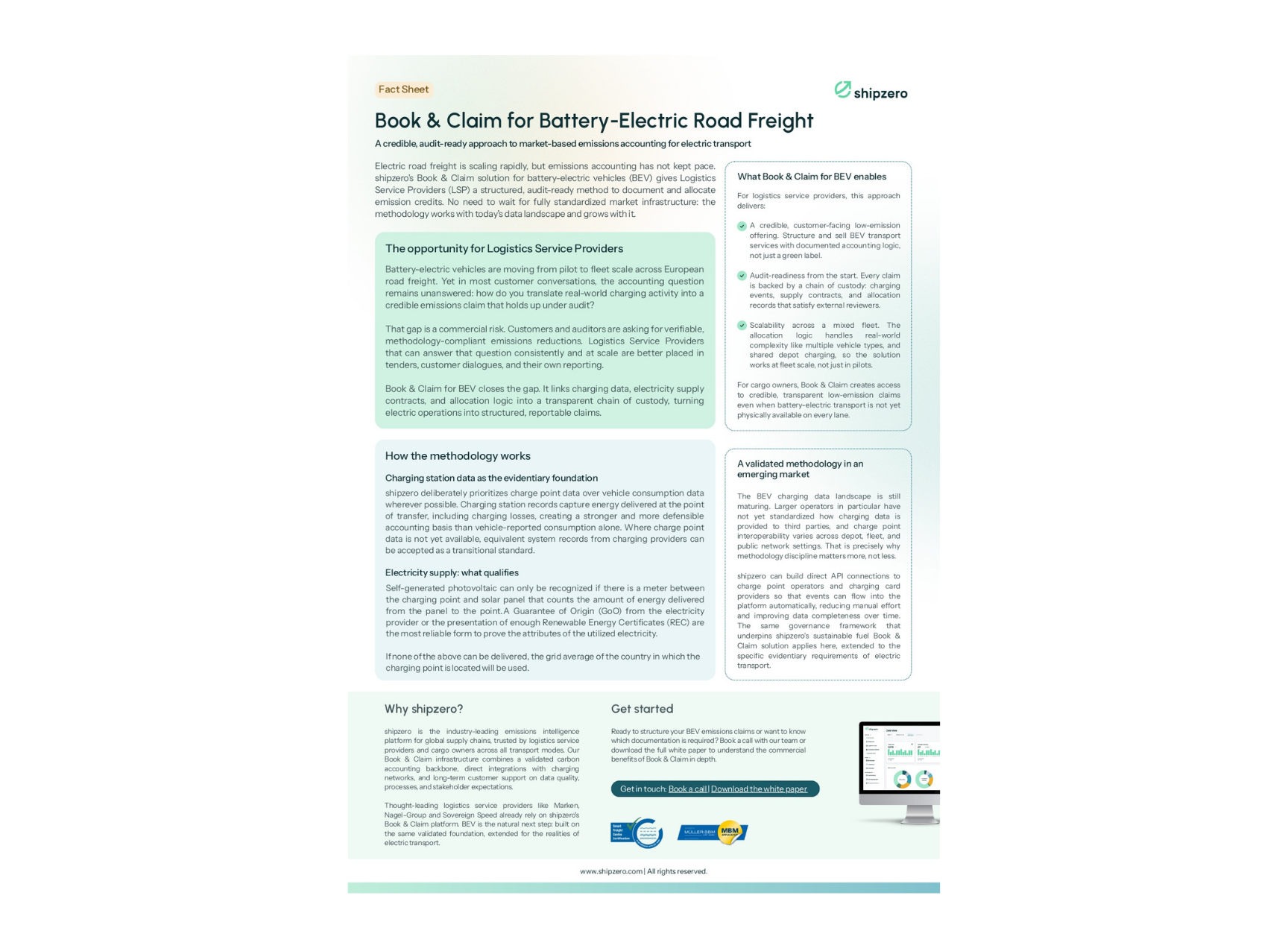
Battery-electric vehicles (BEVs) are moving from pilot to fleet scale across European road freight. Yet in most customer conversations, the accounting question remains unanswered: how do you translate real-world charging activity into a credible emissions claim that holds up under audit?
That gap is a commercial risk. Customers and auditors are asking for verifiable, methodology-compliant emissions reductions. Logistics service providers (LSPs) that can answer that question consistently and at scale are better placed in tenders, customer dialogues and their own reporting.
Book & Claim for BEV closes the gap. It links charging data, electricity supply contracts and allocation logic into a transparent chain of custody, turning electric operations into structured, reportable claims.
What Book & Claim for BEV enables
shipzero's Book & Claim solution for battery-electric vehicles gives LSPs a structured, audit-ready method to document and allocate emission credits. There is no need to wait for fully standardized market infrastructure: the methodology works with today's data landscape and grows with it.
For logistics service providers
- A credible, customer-facing low-emission offering: structure and sell BEV transport services with documented accounting logic, not just a green label.
- Audit-readiness from the start: every claim is backed by a chain of custody of charging events, supply contracts and allocation records, designed for review by external parties.
- Scalability across a mixed fleet: the allocation logic handles real-world complexity such as multiple vehicle types and shared depot charging, so the solution works at fleet scale and not just in pilots.
For cargo owners
Book & Claim creates access to credible, transparent low-emission claims even when battery-electric transport is not yet physically available on every lane.
A structured methodology in an emerging market
The BEV charging data landscape is still maturing. Larger operators in particular have not yet standardized how charging data is provided to third parties, and charge point interoperability varies across depot, fleet and public network settings. That is precisely why methodology discipline matters more, not less.
shipzero can build direct API connections to charge point operators and charging card providers, so that charging events flow into the platform automatically, reducing manual effort and improving data completeness over time. The same governance framework that underpins shipzero's sustainable fuel Book & Claim solution applies here, extended to the specific evidentiary requirements of electric transport.
How the methodology works
Charging station data as the evidentiary foundation
shipzero deliberately prioritizes charge point data over vehicle consumption data wherever possible. Charging station records capture the energy delivered at the point of transfer, including charging losses. This creates a stronger and more defensible accounting basis than vehicle-reported consumption alone. Where charge point data is not yet available, equivalent system records from charging providers can be accepted as a transitional standard.
Electricity supply: what qualifies
- Self-generated photovoltaic (PV) electricity is recognized only if a meter between the solar panels and the charging point records the energy delivered from the panels to the charging point.
- A Guarantee of Origin (GoO) from the electricity provider, or a sufficient quantity of Renewable Energy Certificates (REC), is the most reliable way to prove the attributes of the electricity used.
- If none of the above can be provided, the grid average of the country in which the charging point is located is used.
Key terms explained
- Book & Claim: a chain-of-custody model that separates the environmental benefit of a low-carbon energy source or service from its physical use, so that it can be documented and allocated to a customer claim.
- BEV (battery electric vehicle): a vehicle powered by a battery and an electric motor, without a combustion engine.
- Chain of custody: the documented tracking of a claim along the supply chain, here from charging events and electricity supply to the final allocation.
- Allocation logic: the rules that assign documented emission reductions to specific vehicles, shipments or customers.
- Charge point data: records from the charging station showing the energy delivered to a vehicle, as opposed to consumption figures reported by the vehicle itself.
- Charge point operator and charging card provider: companies that run charging infrastructure or provide the cards used to pay for charging.
- Guarantee of Origin (GoO): a certificate that proves a quantity of electricity was produced from renewable sources.
- Renewable Energy Certificate (REC): a tradable certificate that represents the renewable attributes of one unit of electricity.
- Grid average: the average emission intensity of the national electricity mix.
- LSP (logistics service provider): a company that manages or executes transport services.