Book & Claim: Gaining Competitive Advantage in the Era of Sustainable Freight
Book & Claim is a market-based mechanism that decouples verified low-emission transport investments from specific shipments: a carrier or logistics service provider books the emission reduction it generates at one location, and a cargo owner elsewhere claims it for its own reporting. This guide explains how the mechanism works, how it fits ISO 14083, the GLEC Framework, and the Smart Freight Centre's Voluntary Market-Based Measures Framework, and where it creates commercial value for carriers, logistics service providers, and cargo owners.
The most important facts
- EU transport emissions rose 26 percent between 1990 and 2022 while emissions from other sectors fell 42 percent, with road transport responsible for 73 percent of the sector's total (World Bank, 2025).
- The EU's Corporate Sustainability Reporting Directive (CSRD) requires many companies to disclose Scope 3 emissions, the indirect emissions from a company's supply chain, in more detail than before.
- Book & Claim lets a carrier or logistics service provider book a verified emission reduction where it is most cost-effective to create, and a cargo owner claim that reduction elsewhere, without implying that a specific shipment used the low-emission fuel or vehicle itself.
- Direct Book & Claim ties a claimed unit to the buyer's own supply chain; indirect Book & Claim allows units to be procured from unrelated companies under the Smart Freight Centre's Voluntary Market-Based Measures Framework. shipzero recommends direct Book & Claim.
- shipzero's Book & Claim system and Claim Database are independently validated by Müller-BBM Cert Umweltgutachter GmbH, aligned with ISO 14083:2023 and the Smart Freight Centre's Voluntary Market-Based Measures Framework.
Who this guide is for
This guide is written for two audiences: cargo owners whose procurement, sustainability, finance, and legal teams are weighing Book & Claim as part of a Scope 3 decarbonization strategy, and carriers and logistics service providers whose sales, finance, and operations teams are considering it as a way to monetize investments in low-emission fuels and vehicles.
What is Book & Claim and how does it work?
Book & Claim is a market-based mechanism for attributing a verified emission reduction to a transport buyer, independent of the physical route the buyer's own shipment takes. A carrier or logistics service provider invests in a low-emission intervention, such as sustainable fuel or an electric vehicle, at a location where it is cost-effective, and generates a verified emission reduction there. That reduction is booked as a unit, backed by third-party audits and certificates, and bound to the transport mode and the direct transport chain activity that produced it.
A cargo owner elsewhere then claims the unit for its own carbon reporting. The claim lets the cargo owner count a verified reduction toward its Scope 3 target, but it does not mean the cargo owner's own shipment ran on the low-emission fuel: Book & Claim separates where a reduction happens from where it is reported, and the transaction is documented end to end so both sides can prove what was claimed.
What is the difference between direct and indirect Book & Claim?
In direct Book & Claim, the unit a cargo owner claims is tied to its own supply chain: the carrier or logistics service provider generating the reduction is also moving that cargo owner's freight. In indirect Book & Claim, a cargo owner can instead procure units from unrelated companies, a model the Smart Freight Centre's Voluntary Market-Based Measures Framework for Logistics Emissions Accounting and Reporting also covers. shipzero recommends direct Book & Claim: tying units to a buyer's own supply chain strengthens the claim's traceability and ties the investment to that buyer's own network, rather than treating the unit as a generic, interchangeable certificate.
How does Book & Claim benefit cargo owners?
For cargo owners, Book & Claim offers a way to act on Scope 3 targets without redesigning their own operations or carrier network first. Rather than waiting for low-emission options to be available on every lane they use, cargo owners can claim verified reductions from a carrier's or logistics service provider's investments elsewhere in the network, reporting the purchase as a financed reduction in their sustainability disclosures.
This works best as a complement to direct reduction, not a substitute for it. Cargo owners that have already addressed lower-hanging Scope 1 and 2 measures often find Book & Claim units a comparatively cost-effective way to make further progress on Scope 3, provided they keep their own reduction roadmap in place and treat purchased units as one part of it.
How does Book & Claim benefit carriers and logistics service providers?
For carriers and logistics service providers, Book & Claim turns an existing or planned investment in low-emission fuels or vehicles into a sellable product. Instead of a sustainability investment sitting underused because demand for a specific green lane is limited, the resulting verified reductions can be booked as units and sold to cargo owners anywhere in the carrier's network. That creates a revenue line that helps finance the underlying fleet or fuel investment, and gives sales teams a concrete, auditable proof point in tenders that ask for decarbonization evidence.
What is “Bring Your Own Fuel,” and how does it fit into Book & Claim?
Bring Your Own Fuel (BYOF) lets a cargo owner procure a sustainable fuel such as HVO directly, for example through fuel cards with a fixed carrier partner or a mobile fueling station at its own site, while still working with a carrier network that may vary by lane or season. It follows the same logic as Book & Claim: the cargo owner secures and finances the low-emission fuel itself, and the resulting verified reduction can still be booked and claimed without requiring every carrier it works with to hold its own fuel inventory.
How can a company scale Book & Claim from a pilot to an enterprise-wide program?
Moving from a first pilot to a program that runs across regions and business units works best as a staged process. Define the stakeholders and governance first, including who can allocate and use the resulting units. Assess whether the data an auditable claim needs, such as transport activity, fuel consumption, and proof-of-sustainability documents, is actually available. Set a scaling plan that defines which regions, entities, and strategies come first. Run a small, time-boxed pilot, typically three to six months, on a single lane or client to test claim accuracy and internal processes. Only then roll out at scale, reviewing the program annually as data quality and market conditions evolve.
How does shipzero ensure independence and compliance in Book & Claim?
shipzero operates as an emissions-management specialist rather than a transport broker, fuel seller, or goods trader, which keeps it independent of the Book & Claim transactions it helps manage. Its Book & Claim system and Claim Database are independently validated, aligned with ISO 14083:2023 and the Smart Freight Centre's Voluntary Market-Based Measures Framework for Logistics Emissions Accounting and Reporting, with annual external audits.
All transactions are logged and traceable, with documentation covering the calculations and reviews behind each claim, so a cargo owner, carrier, or auditor can trace a specific claimed reduction back to the intervention that generated it.
In their own words
“With shipzero's Book & Claim module, we have created a transparent solution for our customers to decarbonize their supply chains in a credible and flexible manner, thereby achieving their own sustainability goals.”
Maurice Landwehr, Sustainability Manager, Nagel-Group
What the full white paper adds
The full white paper adds the departmental detail a page cannot: tailored guidance for procurement, finance, legal, and IT teams on both the cargo owner and carrier side, a complete walkthrough of the five-step scaling framework, shipzero's wider partner network, and the full reference list behind every claim made here, from EU transport-emissions data to Book & Claim market growth forecasts.
Frequently asked questions
What is Book & Claim?
Book & Claim is a market-based mechanism that decouples a verified low-emission transport investment from the physical shipment a buyer books. A carrier or logistics service provider books the emission reduction where it is generated; a cargo owner elsewhere claims it for its own carbon reporting.
Does claiming a Book & Claim unit mean a shipment used low-emission fuel?
No. The claim documents a verified emission reduction generated elsewhere in the carrier's or logistics service provider's network, not that the specific shipment being booked ran on low-emission fuel or an electric vehicle. The two are deliberately decoupled, and the documentation behind each transaction makes that distinction explicit.
What is the difference between direct and indirect Book & Claim?
Direct Book & Claim ties a claimed unit to the buyer's own supply chain. Indirect Book & Claim allows units to be procured from unrelated companies, a model also covered by the Smart Freight Centre's Voluntary Market-Based Measures Framework. shipzero recommends direct Book & Claim, for the stronger link it creates between a buyer's spend and its own network's decarbonization.
How does CSRD affect Scope 3 reporting for transport emissions?
The EU's Corporate Sustainability Reporting Directive requires many companies to disclose Scope 3 emissions, the indirect emissions from their supply chain, in more detail than before. For cargo owners, that typically means tracking transport emissions more granularly, which is part of why Book & Claim as a financed-reduction mechanism has drawn more attention.
How is shipzero's Book & Claim system validated?
shipzero's Book & Claim system and Claim Database are independently validated, aligned with ISO 14083:2023 and the Smart Freight Centre's Voluntary Market-Based Measures Framework, with annual external audits.
Who is this guide for?
The guide is written for cargo owners evaluating Book & Claim as part of a Scope 3 decarbonization strategy, and for carriers and logistics service providers evaluating it as a way to monetize investments in low-emission fuels and vehicles.
About this white paper
Published by shipzero, Hamburg, 2026. English.
Further reading
- Nagel-Group case study: building a verified emissions data foundation – https://www.shipzero.com/case-studies/nagel-group-book-and-claim-scope-3
- Blog: the EU Omnibus Package and its impact on sustainability reporting – https://www.shipzero.com/blog/omnibus-package-impact-sustainability-reporting
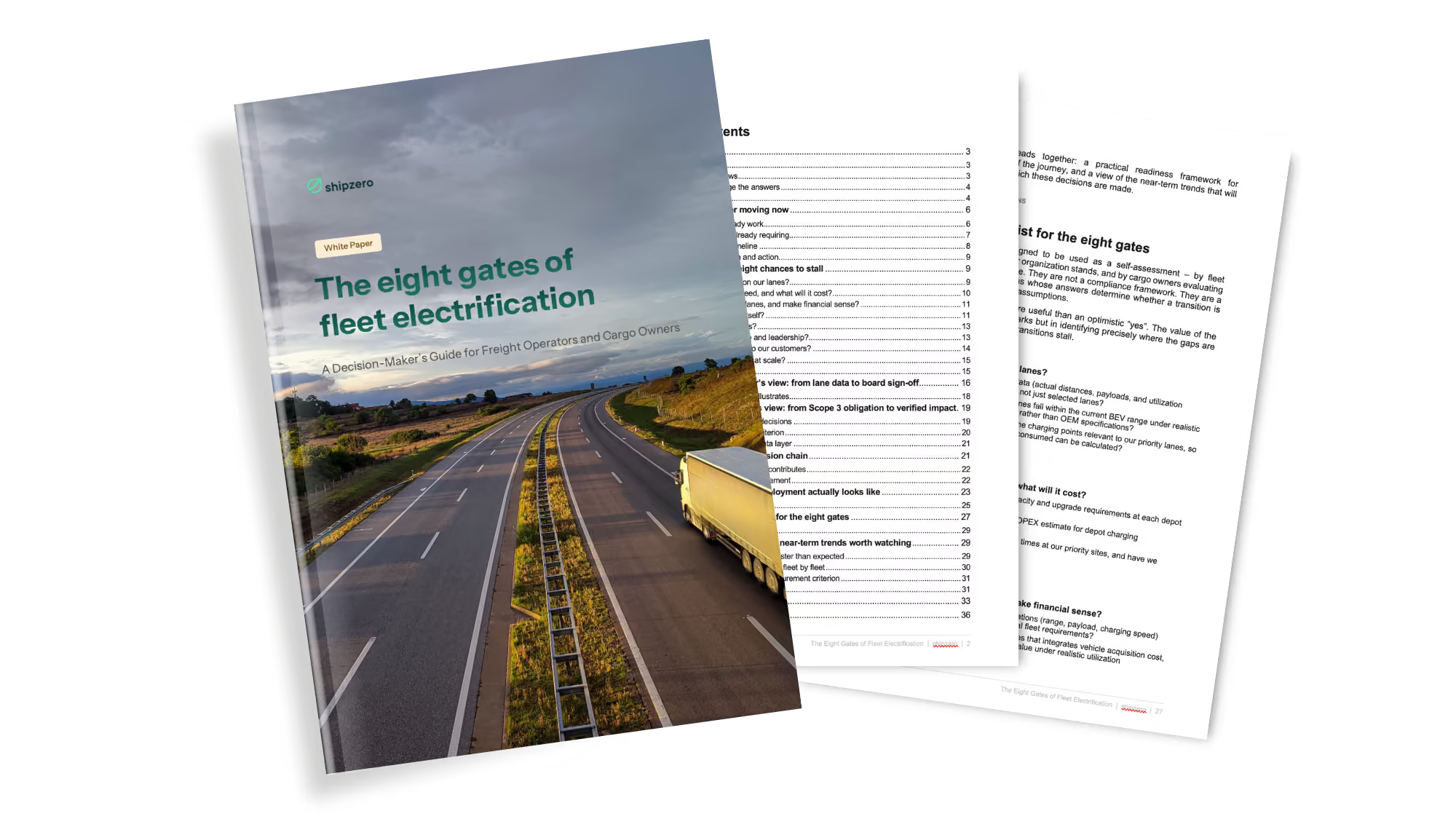
- White paper: The Eight Gates of Fleet Electrification – https://www.shipzero.com/downloads/white-paper-eight-gates-fleet-electrification
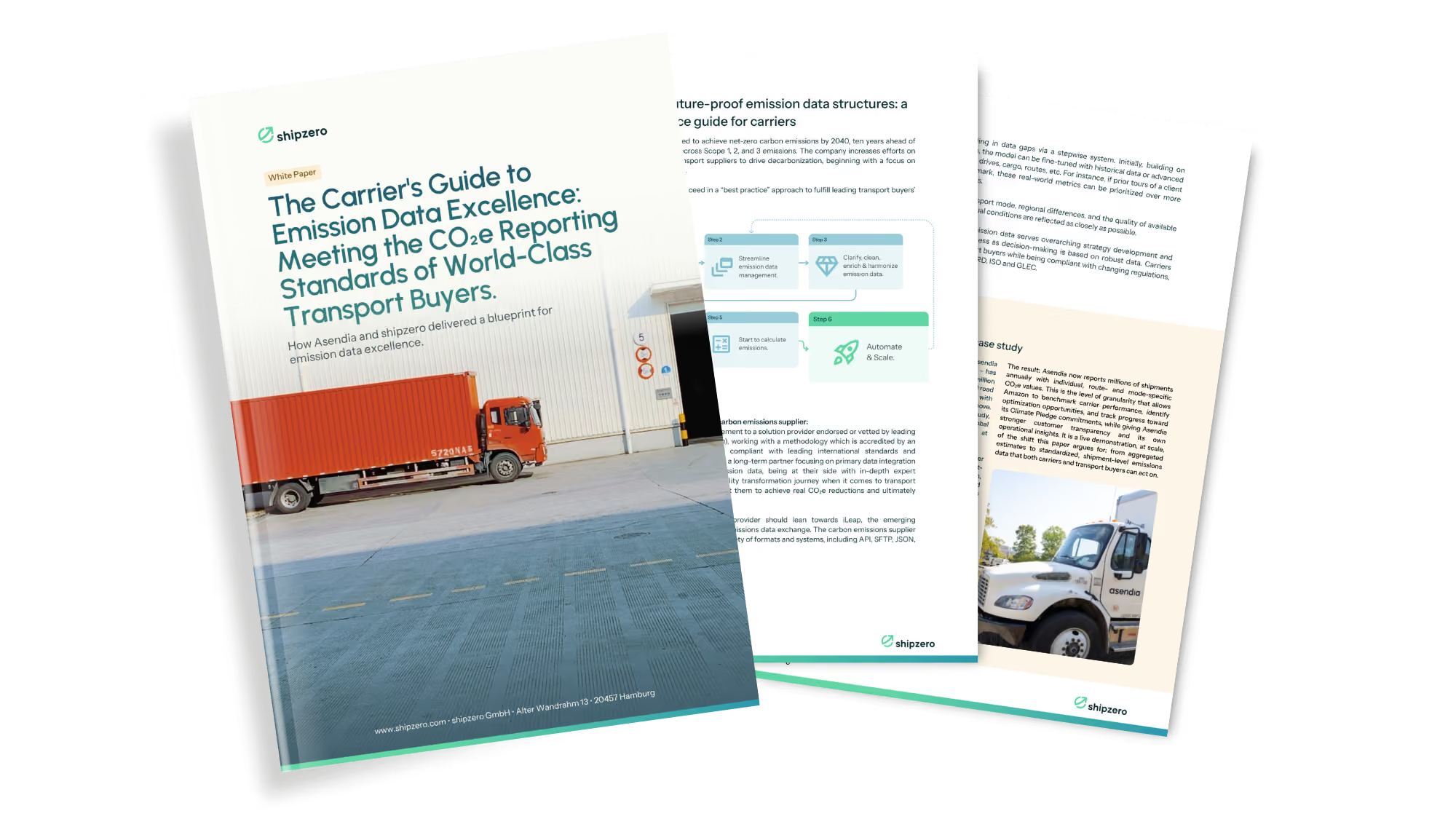
- White paper: The Carrier's Guide to Emission Data Excellence – https://www.shipzero.com/downloads/white-paper-emission-data-excellence-carrier-guide
- Downloads overview page – https://www.shipzero.com/downloads

Used by the world's leading companies




More resources you'll find valuable