

ISO 14083 standard: 5 key insights for precise emissions calculation in transport and logistics
The ISO 14083 standard provides a global approach to quantify and report greenhouse gas emissions in multimodal and worldwide transportation chains. Learn with this article for which companies it’s relevant and how it differs from existing frameworks and guidelines.

Key Takeaways
- ISO 14083 is the global baseline for quantifying and reporting GHG emissions across multimodal transport chains, including transport legs and hubs.
- It separates accounting from offsetting: emissions must be reported without subtracting offsets or ETS certificates.
- Accuracy depends on inputs and factors: use primary data where possible, calculate at leg/hub level, and be mindful that ISO fuel factors may lag – the latest GLEC Framework version is often the more up-to-date practical companion.
Action checklist
- Define your system boundary (legs + hubs) and document what’s excluded (e.g., capital goods, commuting).
- Prioritize primary activity data; use defaults only as a fallback.
- Use current emission factors (e.g., via latest GLEC updates) and keep a clear audit trail for reporting.
The path to an international carbon accounting standard
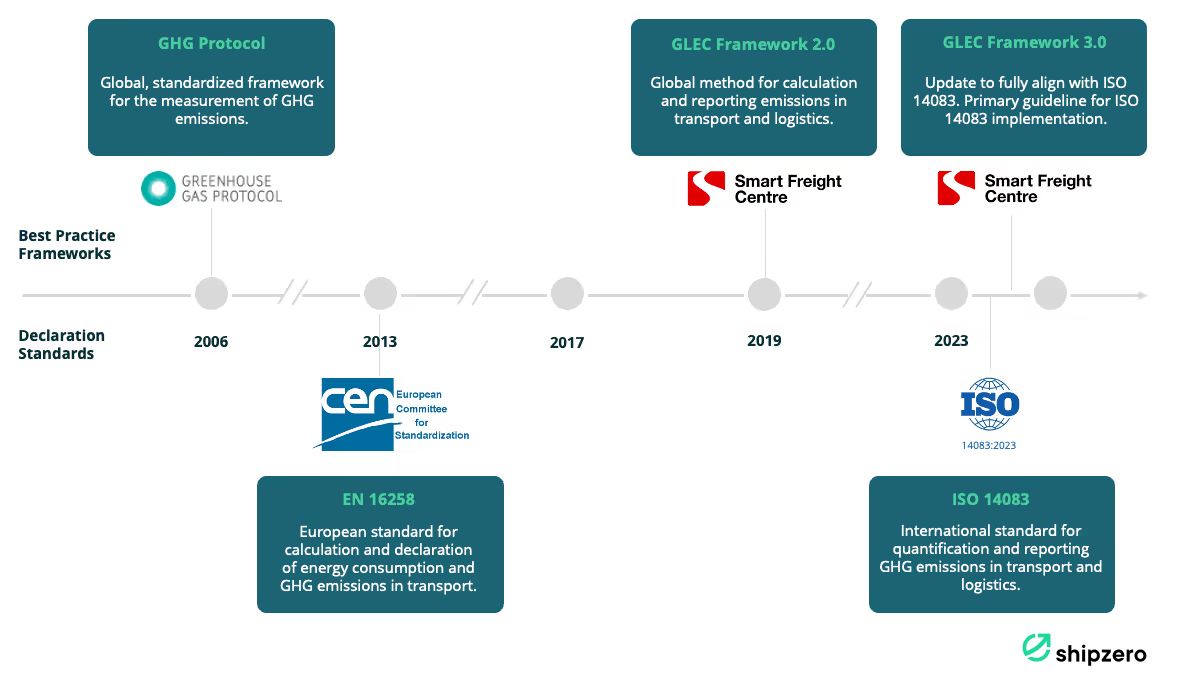
The introduction of the ISO 14083 marks a new phase of global standardization of GHG emissions accounting and reporting in logistics. This standard builds on a decade of development and incorporates established accounting principles such as EN 16258, GHG Protocol, and the GLEC framework for accounting and reporting logistics emissions (figure 1). As a result, this will enable a broader range of stakeholders, including logistics companies, customers, investors, governments, and international bodies, to widely adopt and embrace these principles. The new standard serves as the latest consensus for calculating and reporting logistics emissions, providing a reliable and consistent approach for all stakeholders involved.
1. Unlocking the scope of ISO 14083: What is covered?
ISO 14083 is a comprehensive guideline that provides the necessary steps for effective data collection, calculation and reporting of greenhouse gas emissions in a global supply chain.
Which important aspects of transport chain are addressed by ISO 14083?
Transport modes covered:
Whether air, rail, road, sea, inland waterway, pipeline or cable car transport, the ISO 14083 standard provides specific guidelines for data collection and reporting. Detailed information distinguishes between mandatory, voluntary, and excluded data elements, making it easier for companies to determine what is essential to their calculations.
Types of hubs covered:
ISO 14083 recognizes that emissions generated within transportation hubs should be accounted for as a part of the transport chain. It encompasses a wide range of hubs, including rail and road terminals, cross-docking sites, airport terminals, seaport terminals, and distribution centers. If primary data from hub-related services is not available, secondary data (e.g., throughput processed) can be used to estimate GHG emissions.
Offsetting accounting:
While carbon offsetting actions and emissions trading are important tools in many companies’ climate strategies, ISO 14083 emphasizes their separation from GHG emissions quantification and reporting. This means that the outcomes of offset measures or GHG emissions trading, such as the EU Emissions Trading System (ETS) or any carbon offsetting certificates, may not be considered for quantifying and reporting GHG emissions from transport operations.
2. For whom is the new standard relevant?
It is relevant for all organizations that want and need to calculate logistic emissions for the logistic services they use (owned or contracted), e.g., logistic service providers, logistic operators, and cargo owners. It covers freight and passenger transportation and transfer processes (hubs).
3. What are the Highlights of ISO 14083?
Subject of the analysis:
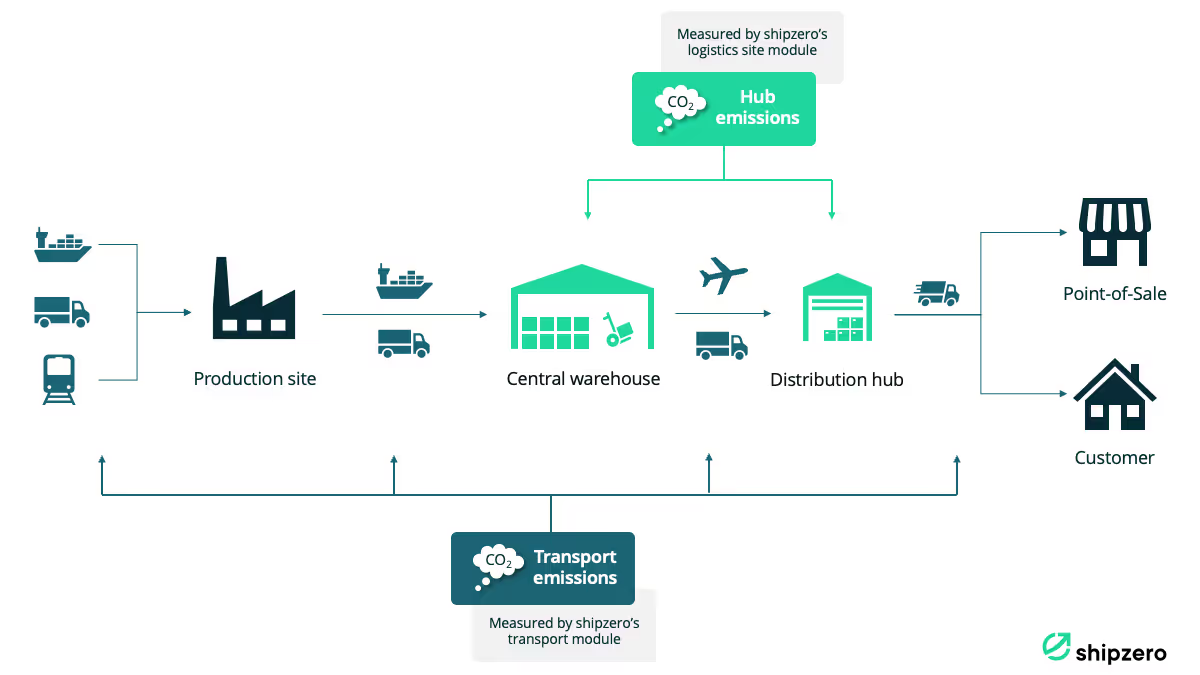
The transport chain and all activities within this chain that cause greenhouse gas emissions. All transport and hub operations required to move freight or passengers from origin to destination are to be considered (see figure 2).
System boundaries:
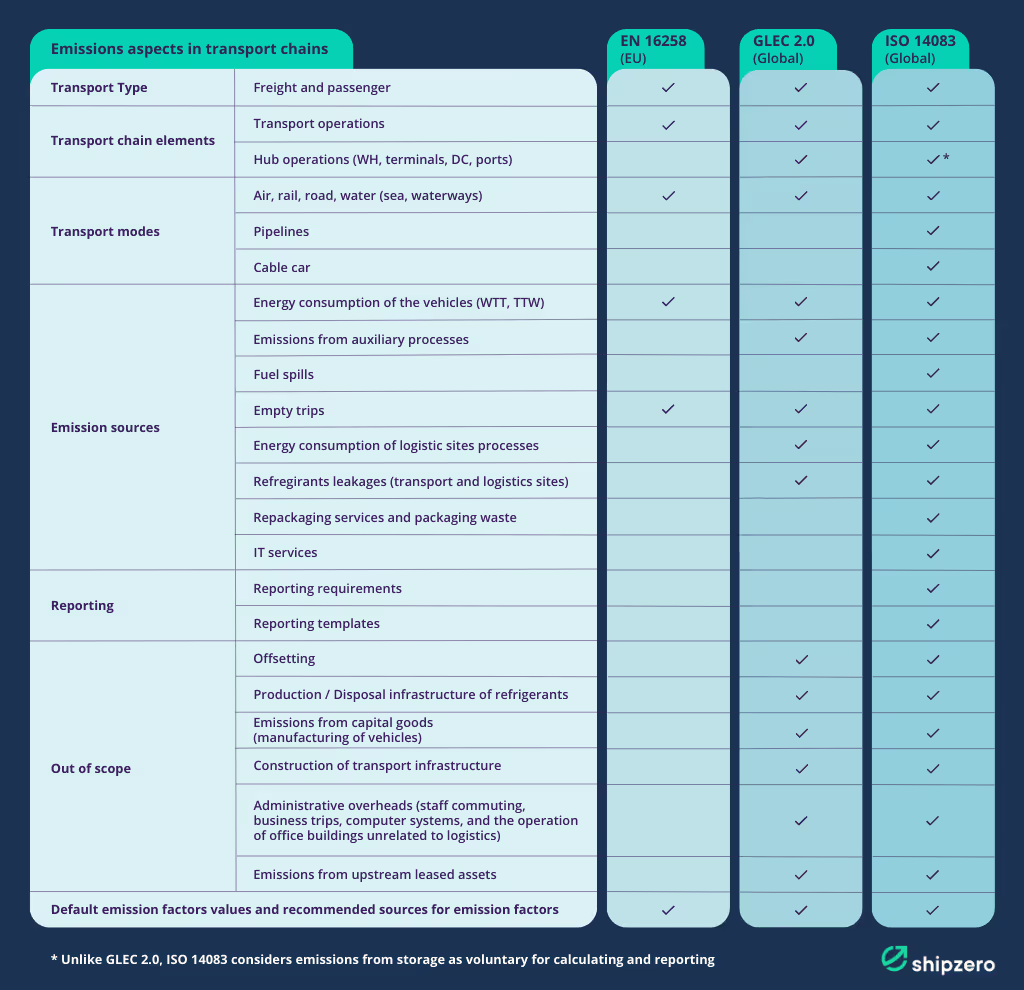
All emissions resulting from a shipment or passenger movement are included in the calculation scope, including all transport and hub operations (table 1).
System boundaries, what is excluded:
Emissions from capital goods (manufacturing of vehicles), business travel, employee commuting, upstream leased assets (assets owned but not used and leased to third parties). Offsetting measures are not subject to accounting and reporting requirements.
Input data:
The ISO standard provides flexibility in the data to be used. Companies are encouraged to use primary data for emissions calculations (e.g., exact volumes of energy and fuel consumed for a logistics operation). However, secondary data (modelled or as a fallback also default values) can be used as a starting point. A set of default values is included in ISO 14083 and GLEC, but the use of default values refers only to the lowest possible level of the ISO standard.
Calculations granularity:
GHG emissions should be calculated at the level of individual transport or hub operations (specific transport leg or hub service). The reporting of emissions is also possible on a clearly defined aggregation level. Aggregation in this case means that transport legs and hub operations with similar characteristics are grouped and the aggregated emission intensity can be applied. This enables an analysis of emission intensity within the company across different locations and time periods as well as benchmarking outside the industry.
4. What are the limitations of ISO 14083?
ISO 14083 not only outlines principles for carbon accounting and reporting but also provides a set of fuel emission factors. However, recent research has shown that the crude oil production datasets used to derive those emission factors for fossil fuels significantly underestimate methane leakage and therefore the associated emissions during fuel production and transport.
It is therefore recommended to use alternative emission factor sources, such as the latest GLEC Framework, which already incorporates the most up-to-date findings on higher emissions from fossil fuel production.
5. What are the differences between ISO 14083 and the GLEC Framework?
The GLEC Framework is a key industry guide for implementing the complex principles outlined in ISO 14083. While fully aligned with the ISO standard, it is written in a more accessible language and supplemented with practical examples to facilitate real-world application.
Following the release of ISO 14083 in March 2023, the GLEC Framework underwent two updates:
GLEC Framework v3.0 (September 2023)
- Full alignment with ISO 14083
- Contains (compared to ISO 14083): Practical examples and industry best-practice; Emission intensity values in addition to fuel emission factors; Refrigerant emission factors
- Does not contain (compared to ISO 14083): Passenger transport; Guidance for calculating GHG emissions from ICT equipment; Quantification of black carbon emissions
GLEC Framework v3.1 (October 2024)
- Mainly updates of emission factors and intensity values compared to GLEC Framework v3.0
- Updates: Inclusions of operational biogenic GHG emission values for bio-based fuels; Incorporation of emission intensity default values for China; Measuring and reporting of GHG emissions for Electric Freight Vehicle Operations; Uplift to relevant emission intensity values to account for “out of route trips and deviations” for air, road and sea
The GLEC Framework’s dynamic nature ensures more frequent updates compared to ISO 14083, making it a preferred resource for up-to-date emission factors and best practices in GHG accounting for transport emissions.
The table below summarizes the main aspects covered by ISO 14083 and the differences with EN 16258 and GLEC Framework 2.0
6. Is the data platform shipzero compliant with ISO 14083?
Yes, the shipzero data platform is in accordance with the ISO 14083 standard, as well as the GLEC Framework. We ensure that our emissions calculation platform:
- enables accounting of GHG emissions throughout transport chains of our clients, according to the guidelines and standards recognized by the logistics industry
- incorporates the latest officially published emission factors
- allows emissions allocation on a shipment and a customer (consignee) basis.
The following figure illustrates the elements of the transport chain for which GHG emissions shall be calculated according to the ISO 14083. All these elements are captured via the shipzero modules “Transport” and “Logistics Site” so that our customers can accurately calculate all emissions of the transport chain on shipment level.
For cargo owners managing Scope 3 reporting obligations under CSRD or SBTi, see how shipzero's carbon accounting and Book & Claim solutions apply these standards in practice.
An expert view can help – we support you with your carbon accounting in compliance with the ISO 14083 standard. shipzero enables companies to measure and analyze emissions data for reporting and analysis to identify reduction potential for your path towards net-zero.
FAQ
Q1: What is ISO 14083 and why does it matter for logistics?
ISO 14083 is the international standard for quantifying and reporting greenhouse gas emissions from transport chain operations, published in March 2023. It provides a globally consistent methodology covering all transport modes – road, rail, sea, air, inland waterway – and all hub types, from seaport terminals to distribution centers. For logistics companies and cargo owners, it matters because it establishes a single, auditable baseline for emissions calculation that regulators, customers, and auditors recognize internationally. It replaces the fragmented approach of EN 16258 and other regional frameworks with a unified global standard.
Q2: Who does ISO 14083 apply to?
ISO 14083 applies to all organizations that calculate GHG emissions from logistics operations – whether they own or contract those services. This includes logistics service providers calculating emissions for their operations and client reporting, cargo owners calculating Scope 3 Category 4 (upstream transport) and Category 9 (downstream transport) emissions, and multimodal operators managing mixed freight across road, rail, sea, and air. It covers both freight and passenger transport.
Q3: What is the difference between ISO 14083 and the GLEC Framework?
ISO 14083 is the formal international standard – comprehensive but complex, and updated infrequently. The GLEC Framework is the practical implementation guide: fully aligned with ISO 14083, written in more accessible language, supplemented with real-world examples, and updated more frequently to incorporate the latest emission factors. GLEC Framework v3.1 (October 2024) includes updated emission factors for bio-based fuels, electric freight vehicles, and China-specific intensity values that ISO 14083 does not yet reflect. For most practical emissions calculation, using the GLEC Framework is both ISO 14083-compliant and more accurate.
Q4: Does ISO 14083 require primary data?
ISO 14083 encourages primary data – actual fuel consumption, vehicle type, and operational data – for maximum accuracy, but does not mandate it exclusively. Secondary data and default values are permissible as fallbacks, though they represent the lowest quality tier under the standard. Using default values for all calculations does not constitute full ISO 14083 compliance in the spirit of the standard – it meets the minimum threshold but leaves significant accuracy gaps. For CSRD disclosure and SBTi target submission, auditors increasingly expect primary data where operationally feasible.
Q5: How does ISO 14083 relate to CSRD and SBTi reporting?
ISO 14083 is the calculation methodology underlying Scope 3.4 and 3.9 transport emissions reporting required under CSRD's ESRS E1 framework. Companies within CSRD scope must report transport emissions using a recognized methodology – ISO 14083 and the GLEC Framework are the accepted standards. For SBTi V2.0, ISO 14083-aligned emissions data forms the baseline for science-based target setting on transport. Companies using market instruments such as Book & Claim for Scope 3 target achievement must additionally ensure their emission reductions are documented against an ISO 14083-compliant baseline to meet SBTi integrity requirements.


Related articles